Five ways to use tarot cards that aren’t fortune telling

I think that most people think of fortune telling when they think of tarot cards – they equate it with using a crystal ball to predict the future. Heck, this is the way I thought of the tarot for years. While a lot of people do use tarot for divination, it’s really limiting to think of it only in those terms. In fact, I use tarot cards every single day but I don’t use them for predictions at all.

So what else can you do with tarot cards? Here’s five ways to use tarot cards that are not fortune-telling or divination.

1. As a prompt for storytelling.

I recently listened to a podcast about how to use tarot as a writer’s tool, and I was fascinated. You can use tarot to look into a character’s motivations, or to discern their personality. You can use tarot to help create random plot twists. You can use tarot to generate character sketches for minor characters, or to create origin stories for your characters. Or just pull a card when asking yourself, “What happens next?”

2. To seek daily mindfulness 

This is my favourite way to use tarot. I try to pull a card each day and ask myself what that card’s energy means for my day. Sometimes I do it looking ahead, but often I will pull it at the end of the day, asking what lessons were brought to me in this day.

This serves two purposes. First, it was terrific when I was trying to learn the card meanings in context of day to day life. Tarot cards show the panorama of human experience, and it’s interesting to see the themes and archetypes at play in our universal experience, and how we manifest the energy of the four suits in our everyday lives.

But more interestingly, it has caused me to pause and really *think* about what the day held. Was it a good day? Why? What went well and what didn’t go so well? Were there lessons to be learned? If you’re feeling extra keen, try journaling your card and what you learned. Are there patterns you can see over time? Are they positive or are they highlighting something that needs attention?

3. To amplify the voice of your inner wisdom

Sometimes the tarot cards are like a trusted friend, one who listens to your concerns and has the perspective and objectivity to point out what you may be missing. Guess what? That trusted friend can be your own inner wisdom, and sometimes hearing it echoed back in the cards is what we need to shine a little light on our blind spots and pull the truth out of the shadows where we’ve been trying to hide it.

Let’s say you’re trying to make a decision between two options: applying for a promotion versus staying with your current job. Lay out three cards: one for the benefits of applying for the promotion, one of the benefits of staying with the current job, and one for guidance on which one to choose. Reading the cards will help clarify your own feelings and intents about each option. Please note that I am absolutely not recommending that you draw cards to make the choice for you. The cards are a tool for insight, not something you should use to absolve yourself of responsibility for your actions. The cards are not the boss of you, YOU are the boss of you.

4. To help set your intentions and your goals

I first came across the idea of intentionally selecting tarot cards face up in a podcast featuring Mary K Greer. (Yes, I’ve been listening to a lot of podcasts these days!) I love the idea of replacing the element of random card selection with intention. What do you need in your life right now? What energy do you need to bring into your life? Let’s say you’re thinking about your career.

Pull all the Pentacles cards from your deck and lay them face up in front of you. (Pentacles are the suit of our worldly material concerns – job, finances, home.) Scan the cards. Which one speaks to you? Maybe it’s the Eight of Pentacles, which shows an apprentice hard at work on their craft. Study the card. Look at the symbols, the colours. What draws you? What insight does the card offer. Is there anything you’ve never noticed before? Why is that card interesting to you right now? Do you relate to the careful diligence of applying your skill? Or is it time for you to add a new skill to your toolbox? Are you doing things in your life that will help you evolve into a hardworking, trustworthy individual who is a master of their skills? What can you do to take the first steps on that journey? Then identify any obstacles in your way. How can you address or overcome those obstacles? This is a great exercise, and you can build a great mind map just drawing on your own inspiration taken from the elements of a single card.

5. To generate random encounters in Dungeons and Dragons

Okay, I will admit, this one is niche. You might not be a Dungeon Master looking for inspiration on how to create interesting NPCs or random encounters in the fantasy world you are building, but I think it’s an amazing (and close to my D&D loving heart) example of some of the weird and wonderful ways that tarot can be used outside of divination. I came across this post on Reddit where the author has explained how they use tarot to generate interesting D&D encounters. They draw a card for each of these elements: the goal that the players are trying to reach, the obstacle they face, the hook that draws them, the setting they’re in, the non-player characters who might also be present, and the villain of the encounter. It’s like creativity-in-a-box, and you can see the obvious parallels to my earlier point about storytelling. It also reminds us that in its origins, tarot was simply a card game, and sometimes it would do us well to remember the more lighthearted side of the cards.

Heck, if you’re looking for a less esoteric way to play with your tarot cards, how about a simple game of War or even Go Fish? After all, tarot cards were originally simply a card game not unlike Hearts or Euchre.

The message here is that using tarot cards for fortune telling is really just a tiny bit of the spectrum of possible ways you can use them. You can use them for inspiration, for introspection, for creativity, for play. The only limit is your own imagination. And if you happen to be someone who thinks they can predict the future too, more power to you!

What do you think? Have you heard of other wild and wonderful ways to bring the tarot cards into your everyday life?
Tarot and Myers-Briggs Personality Indicators

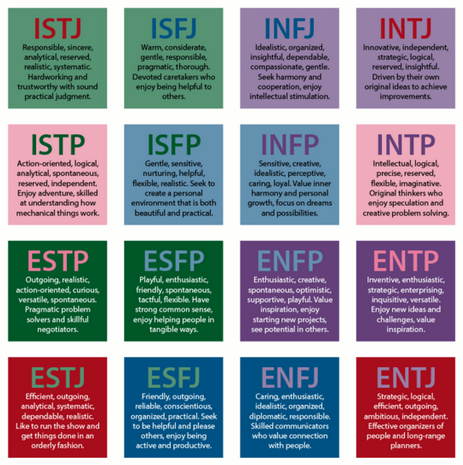
Discovering my Myers-Briggs personality type back in 2010 or so rocked my world. I’d only vaguely heard about the MBTI before, and took the assessment as an exercise during a leadership course through work. Learning about my personality type and how it affects things like how I take in information and stimulus, how I interact with the world and others, and seeing it in the context of how it affects my behaviours, was a lightning bolt of insight that has had long-lasting effects for me. It was one of the first times I had a clear and deep insight into the mystery that is me, and I have used it to great success in understanding my relationships with others, and how their personality types govern their behaviours as well. Having grown so appreciative of knowing my MBTI, it was a shock of recognition to see the same deep understandings into my life possible through tarot cards.

Are you familiar with the Myers-Briggs Type Indicator (MBTI)? It’s rooted in Carl Jung’s theory of personality as expounded in his book Personality Types. Jung believed that we are governed by four primary cognitive functions: thinking, feeling, sensation, and intuition. Each of these manifests itself in one of two orientations, either extraverted or introverted, yielding a total of eight “dominant” functions. Elaborating upon Jung’s work in subsequent decades, Katharine Cook Briggs and her daughter Isabel Myers refined the theory by adding two secondary personality types, “judging” and “perception”, which also take extra- or introverted forms. These two extra elements, in combination with the others previously mentioned, yield a possible of 16 personality “types,” each of which is represented by a four-letter abbreviation. (Source)

Myself, I am an ENFP, the most introverted of the extroverts. Reading the characteristics common to other ENFPs was a huge series of “aha!” moments for me. So many things about me crystallized into cognizance when I started looking into it: how I am happiest on my own in a crowd, how I think through any situation  by speaking to others about it, how I love to interact with other humans but find it exhausting, how I am driven to find connections and meaning in the chaos of human experience. (Hello, tarot cards!) So while I’m far from an MBTI expert, I certainly am grateful for the insight into my own personality that I’ve received through the lens of MBTI.

I’d only scratched the surface of learning about tarot when I started seeing the parallels between MBTI and tarot. Both are deeply connected to Jungian psychology, with ideas of archetypes and the collective unconscious. Both use an external tool to help you elicit, categorize, and make sense of patterns and behaviours that are already ingrained within you. Neither tells you something that isn’t already there. Both can be used to help you understand your own motivations from an objective perspective. Both are adored and reviled by opposing camps. 😉

The four suits of tarot are each representative of an element, and can be linked directly to the four Jungian primary functions of MBTI as follows:

Wands -> Fire -> Intuition

Cups -> Water -> Feeling

Swords -> Air -> Thinking

Pentacles -> Earth -> Sensation

Further, in tarot the “court” cards are the Page, Knight, Queen and King of each suit, and are often seen as representative of people or personalities in our lives (as opposed to the major arcana, which are archetypal experiences, and the minor arcana pip cards, which cover, in the words of Rachel Pollack, “aspects of life as people actually live it.”) So we have 16 court cards and 16 MBTI personality types, each combining various levels of the four primary functions / elements. While I see this as too much of a coincidence to be an accident, I am not quite proficient enough in either MBTI or tarot to ascribe a court card to each personality type, but this blogger seems to have taken a good run at it. I’m not sure I’m 100% on board with his interpretations, but I think I’ll need a little more experience in both tarot and MBTI to figure out how to ascribe the dominant and auxiliary functions correctly to more perfectly match up the court cards and personality types.

I definitely see myself doing more research into MBTI and tarot – there are just so many linkages. How about you? Are you a fan of MBTI or tarot or both, and have you noticed the strange congruence of personality types, suits, elements, and court cards? What has your experience been?

Taking a walk with the elements of the tarot

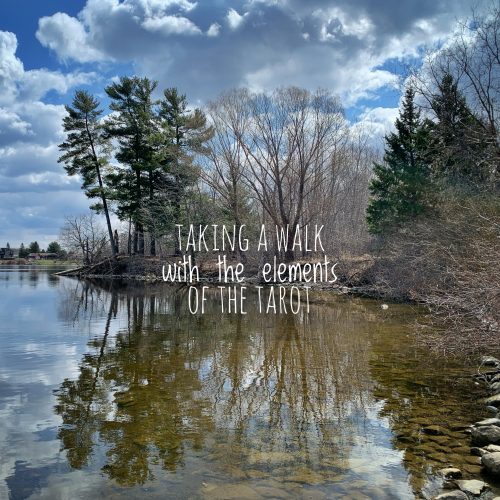
We’re still pretty much on isolation lockdown here and the weather has been cold and more like the end of winter than the beginning of spring. Today, though, the sun was shining and I took a long walk along my muse, the beautiful Rideau River. As I walked, I noticed how the elements of the tarot were all around me.

Of course, the flowing river is water, element of the suit of cups, and our link to intuition and emotion. It’s in the dewdrops on the leaves, and in me, too. The ground beneath my feet, still saturated with melted snow and smelling so deliciously of mud and springtime, is of course the solid, grounding element of earth. That earthly pentacles energy is also in the rocks, the trees, the greening grass and shrubs, and all the things we can touch and feel and hold.

The cool spring breeze ruffling my bangs back off my face is the air, element of the suit of swords; the same sweet air I breathe deeply as I stand at the edge of the river and sigh happily. And last but not surely not least is the element of the action-oriented wands: fire. I feel it on my face as I turn up to let the blazing sun imprint a few more freckles across the bridge of my nose. I feel that fiery energy, too, as I use the strong muscles of my legs and my core to climb up a small embankment. I feel that powerful life energy in the tiny buds on bare branches, biding time like the Hanged Man until the moment when they unfurl into the sunshine, heralding the end of a long winter and the arrival of summer at last.

I’m so grateful to the tarot for giving me this framework to appreciate the delicate balance of the elements of life’s energy all around me on a beautiful and exquisitely ordinary spring morning. I promise myself that I’ll remember this moment, this feeling of connecting to the elements of the universe, as I move through my day. I take with me the gift of mindfulness, and of gratitude for the fiery energy, the sweet-smelling air, the grounding earth and the endlessly flowing water, connecting me to the world, and to myself.

Tarot Reading: Advice for parenting a teenager

I gave a friend a tarot reading the other day, and thought I’d share it here. She’s got a teenage boy, and had asked for insight on how to balance a tough-love approach with giving him freedom to grow, especially as he struggles with peer pressure.

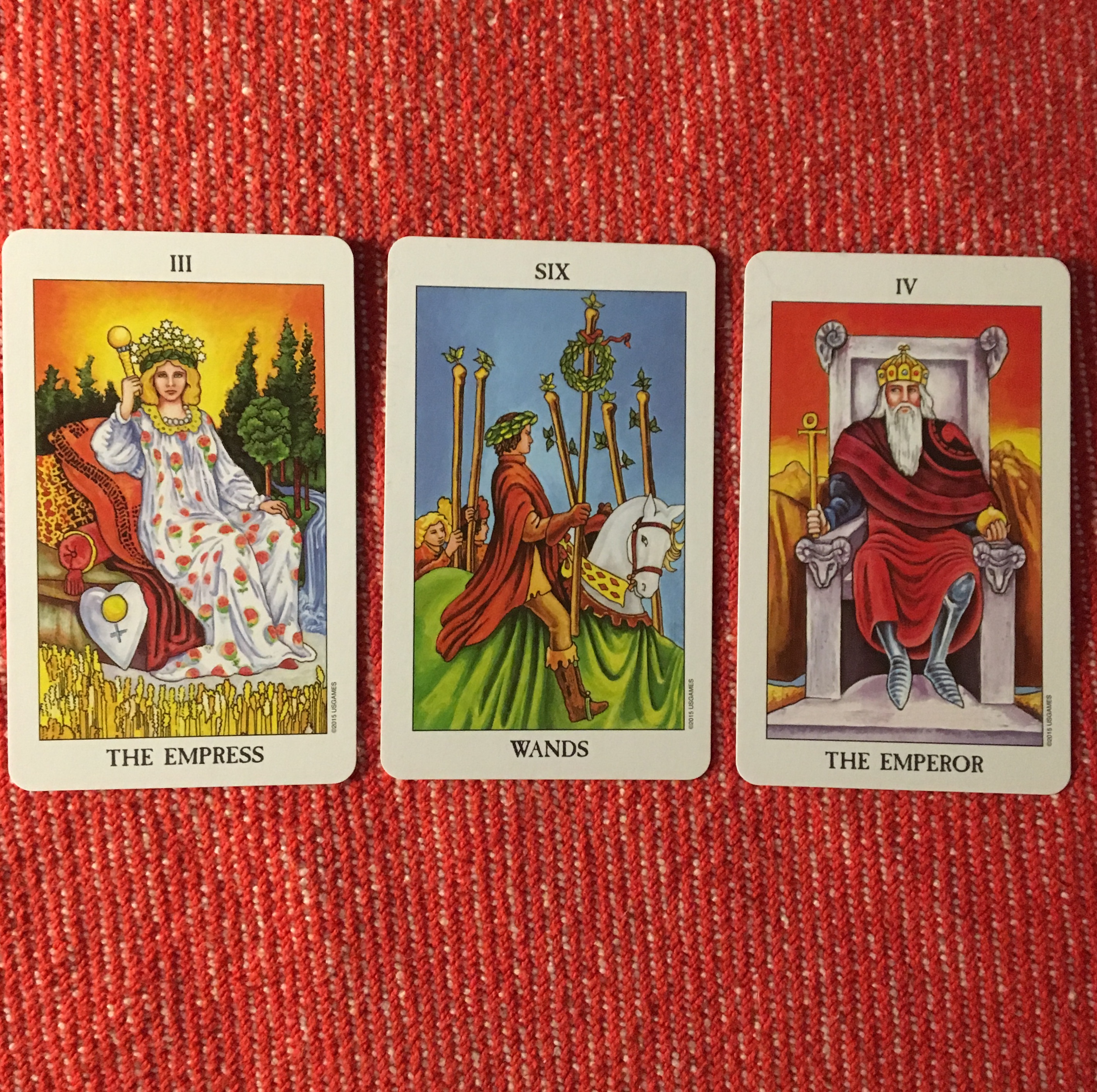
I asked the cards for insight into her relationship with her son, and some guidance on how to handle his need to grow and rebel versus her need to control and stay sane. I pulled three cards: The Empress, The Six of Wands, and the Emperor.

I laughed when I drew these cards because the Empress and Emperor are classic parental archetypes of mother and father energy. Hello Captain Obvious! Seriously, the cards are screaming DO YOUR JOB, this boy needs to be parented and hard. The Six of Wands is called Victory, and here is obviously the chaotic energy of a young person burning to be out on the path of their life. Together, the tableau says the seeker needs to exert traditional parenting energy to keep her son on the path, but it will end with great success.

The Empress is full of nurturing mother energy, and the Emperor is a no-nonsense but kindly sovereign who rules with benign but unmistakable control. His throne is made of stone – this is not a person who compromises. The Empress, on the other hand, is full of round, soft curves, draped on a comforting pillow. The Six of Wands, bursting with the fiery action-oriented energy of the wands, is bookended between them, saying the seeker and her husband really need to find the balance between the softer and firmer approach in dealing with his burning youthful energy. 

Wands are about action and motion, and they’re hard to contain. Their element is fire, which means they’re always on the go. Like fire, they can be beneficial when controlled and a disaster when out of control – just like a teenager. 😉 I think this card shows how he’s really feeling peer pressure as well – it’s like the crowd in the photo represent his friends and acquaintances, egging him on. That’s the force his parents need to control and mitigate between the Empress’s nurturing nature and the strictness of the Emperor’s rules.

In a traditional sense, we could read the mom as the Empress and the Emperor as dad, but I think in a more modern sense, both parents can be each card. Digging a little deeper, if you look at the colour of the background of the cards, you can see that both the Empress and the Emperor have reds and yellows in the background, contrasting the bright blue of the Six of Wands. The seeker needs to make sure she and her husband are standing together as a unified force, providing clear and firm boundaries and expectations, and providing a united front in showing what those limitations are.

To see two major arcana (the Empress and Emperor) in a three card reading is unusual, and the major arcana are usually indicative of significant crossroads or decision points in our lives. (The minor arcana are more like the quotidian scenes that make up our everyday experiences.) The overall message here is that the seeker needs to find that balance between control and nurturing in order to help their son along his path to being a successful adult.

Isn’t the tarot good at telling you what you already know? What do you think of this reading? Would you interpret anything differently?

If you’d like to request a reading for yourself, please see my “request a reading” page for details.

My fangirl moment over Rachel Pollack, tarot pioneer

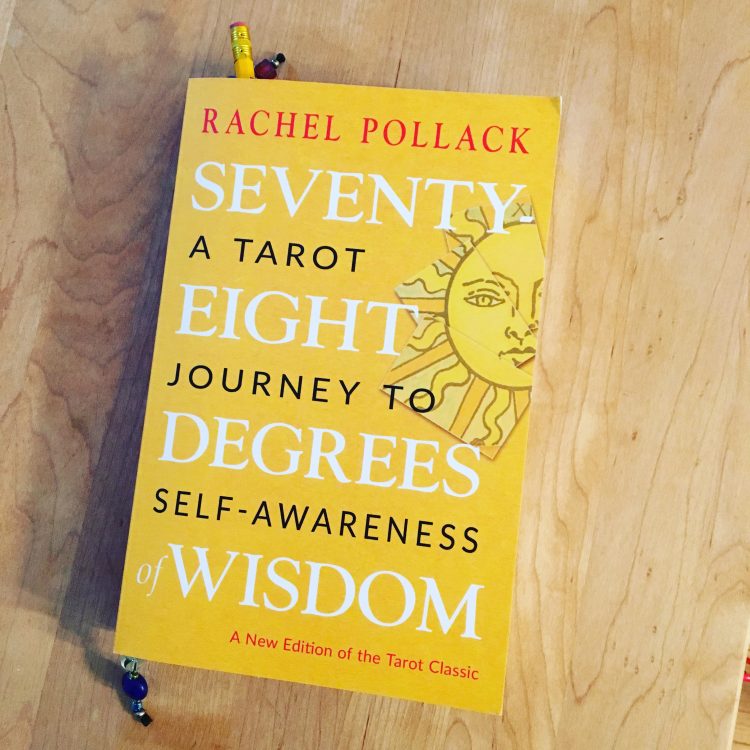
I have been reading Rachel Pollack’s seminal tarot book, 78 Degrees of Wisdom: A Tarot Journey to Self-Awareness. You don’t have to spend very long in the world of learning tarot before someone recommends this book to you. Written as two books (one each about the major and minor arcana) in 1980, it has been through many reprints and updates and since combined into a single tome. I’m half way through it, and have been happily marking up my copy with a pencil, adding underscores, asterisks and even exclamation marks as various insights and connections hit home for me. I seriously love this book.

I have an entire series of blog posts that I would like to write one day, riffing off how this book is blowing my mind. Today, however, on a completely separate front, my mind was blown by her again. For all the times I’ve heard her mentioned or seen her work cited, I never before today realized that she’s transgender. (A lot of the references seem to say transsexual, but as that’s a term that’s fairly anachronistic now, I’ll assume she’d be okay with the more modern term transgender.) Since one of my kids is non-binary and several of my friends are trans, I’m equal parts surprised and delighted that this seems to be a non-issue when people talk about Rachel Pollack. I genuinely hope that this is a sign of trans acceptance in the world.

After a little googling, I pieced together that Rachel, born in 1945, came out as trans to her partner and students (she was a teacher at SUNY) in 1970 at age 25, and had gender-confirming surgery six years later. I can’t imagine how hard it must have been to be out as trans at that time, when even being out as gay was a difficult road. (One of my pet projects at work is as a Positive Space facilitator, teaching workshops on the acceptance of gender and sexual diversity in the workplace, so I have some insight into societal acceptance and tolerance when it comes to LGBTQ folks.)

As if being a tarot goddess, accomplished writer and lecturer, and a trans elder weren’t enough to make her an absolutely fascinating human, she’s also apparently well-appreciated as a science fiction author and comic book artist, too. She’s known for a DC Comics book called Doom Patrol, where she introduced a trans character named Coagula to the storyline.

But wait, there’s more! If that weren’t cool enough, I stumbled across the fact that through DC Comics, she created a Tarot deck called Vertigo with illustrator named Dave McKean, and my all-time favourite author Neil (swoon!) Gaiman wrote the introduction for the accompanying book. My mind is so blown right now I’m having trouble deciding which thread to pull next!

All that to say, I’m now a card-carrying fan girl for Rachel Pollack. In the not-too-distant future, I’ll get a more coherent post out about all the things I love about 78 Degrees of Wisdom. Have you read it? What did you think?